How Do You Know If Training Was Effective?
Completing a course can feel like an achievement. A learner reaches the final lesson, passes the assessment, receives a certificate, and the course is marked as complete.
For training providers and organisations, completion rates are also easy to measure. They can tell us how many people enrolled, how many reached the end, and how many completed the required assessments.
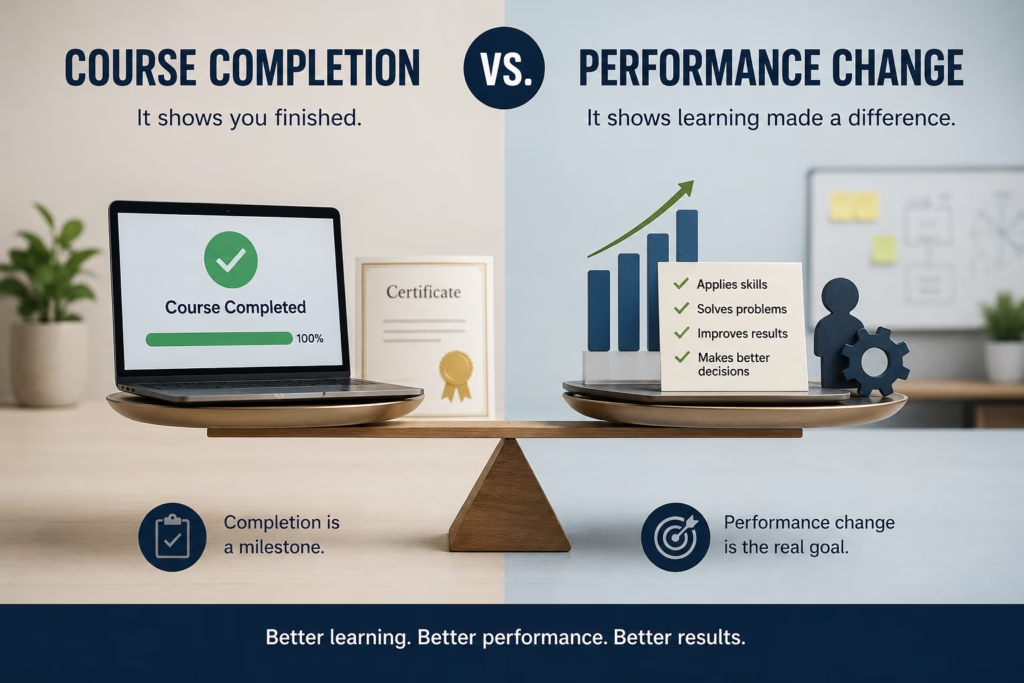
But there is a much more important question:
What can the learner do differently because of the training?
A high course completion rate may look impressive, but completion alone tells us very little about whether learning has resulted in meaningful change.
What Does Course Completion Actually Tell Us?
Course completion is useful information.
It tells us that a learner reached a defined point in a course. Depending on the course design, it may also show that the learner viewed the required content, completed activities, or passed an assessment.
What it does not automatically prove is that the learner can apply what was learned.
Someone can complete a course on Microsoft Excel and still struggle to use the relevant functions at work. A manager can complete leadership training without changing how they manage employees. An employee can pass cybersecurity training and still respond incorrectly when faced with a suspicious email.
The course has been completed, but the desired performance may not have changed.
Why Completion Rates Can Be Misleading
Completion rates are attractive because they are simple to measure.
An organisation can report that 500 employees enrolled in a training programme and 92% completed it. Those numbers provide useful administrative information, but they do not answer the most important question.
Did the training work?
To answer that, we need evidence beyond participation.
A learner remembering information immediately after a lesson is different from being able to apply that knowledge in a real situation. Similarly, passing a multiple-choice assessment does not necessarily prove that someone can perform a practical skill.
This is why training effectiveness should not be judged by completion alone.
Learning Should Lead to Performance Change
The purpose of skills development is normally to help someone know, understand, or do something they could not do before, or to help them perform an existing task more effectively.
That change may be small.
A learner might use a spreadsheet more accurately, communicate more effectively with customers, recognise a security risk, write a better business proposal, or follow a workplace procedure correctly.
These are observable changes that provide stronger evidence of learning than course completion alone.
So, the question changes from:
Did the learner finish the course?
to:
Can the learner now apply what was learned?
Performance Change Is Not Always the Same as Business Results
It is also important not to move too far in the opposite direction.
Training should contribute to useful outcomes, but a course cannot always be judged directly by changes in sales, profit, productivity, or other business results.
Many factors can influence those results.
For example, a salesperson may improve how they communicate with prospective customers but still experience lower sales because market demand has declined. A manager may improve their leadership skills in an organisation experiencing wider operational problems.
A more useful first question is whether the learner’s knowledge, skill, behaviour, or performance has changed in the intended direction.
Business results can then be considered as part of the wider evaluation.
How Can We Measure Whether Training Worked?
The appropriate evidence depends on what the course is intended to achieve.
Knowledge may be assessed through questions or problem-solving activities. Practical skills may require demonstrations, projects, simulations, or workplace tasks. Behavioural change may require observation or feedback over time.
Other useful measures could include changes in error rates, work quality, task completion, customer interactions, or the ability to perform a particular process independently.
The important point is that the evidence should match the learning outcome.
If a course claims that learners will be able to create something, an assessment that only asks them to identify the correct answer may provide limited evidence that the outcome has been achieved.
Course Design Should Start With the Desired Performance
This changes how we think about course design.
Instead of beginning with:
What information should we put into the course?
we can begin with:
What should the learner be able to do differently after completing the course?
Once that has been established, the learning outcomes can describe the expected change. The course content can provide the knowledge and skills required to achieve it, and the assessment can provide evidence of whether the learner has achieved the outcome.
This creates a clearer connection between learning outcomes, course content, assessment, and performance.
Completion Is a Milestone, Not the Final Measure
Course completion still matters. Finishing a programme requires time and effort, and completion data can help organisations and training providers understand learner participation and engagement.
Certificates can also provide useful evidence that a learner has completed defined learning requirements.
But completion should be treated as a milestone rather than the final measure of success.
The real value of learning becomes visible when learners can take what they have learned and use it.
A better measure of training is not simply how many people finished the course, but what changed because they did.
What Should a Well-Designed Course Include?
A well-designed course should have a clear purpose. The content, learning activities, and assessment should all contribute to what the learner is expected to achieve.
A useful starting point is to consider six questions:
- Why does this course exist?
There should be a clear learning or performance need. The purpose should be more specific than simply providing information on a topic. - What should learners be able to do after the course?
Learning outcomes should describe the knowledge or skills learners are expected to develop. - What content is actually necessary?
Course content should support the learning outcomes rather than being included simply because it relates to the subject. - How will learners apply what they learn?
Where appropriate, learners should have opportunities to apply their knowledge through examples, activities, scenarios, problems, projects, or practical tasks. - How will achievement be measured?
Assessment should match the intended outcome. If learners are expected to remember or understand information, knowledge-based assessment may be appropriate. If they are expected to perform a skill, the assessment should provide reasonable evidence that they can perform it. - What would successful performance look like outside the course?
The answer should connect back to the reason the course was needed. In a workplace context, success might mean fewer errors, better decisions, improved communication, correct use of a process or tool, higher-quality work, or greater independence in performing a task.
The important part is the relationship between these elements:
Need → Learning Outcomes → Content → Application → Assessment → Performance
When these elements support each other, course completion becomes more meaningful because the course has been designed around what learners should ultimately know or be able to do.
Related Reading
Artificial intelligence is also changing how online learning is developed and delivered. Read AI in Online Learning: What Is Changing and What Still Matters to explore the role of AI in online education.
I would hyperlink the article title, rather than words such as “click here.” That gives Google and readers clearer context about what the linked page covers.